Interviews

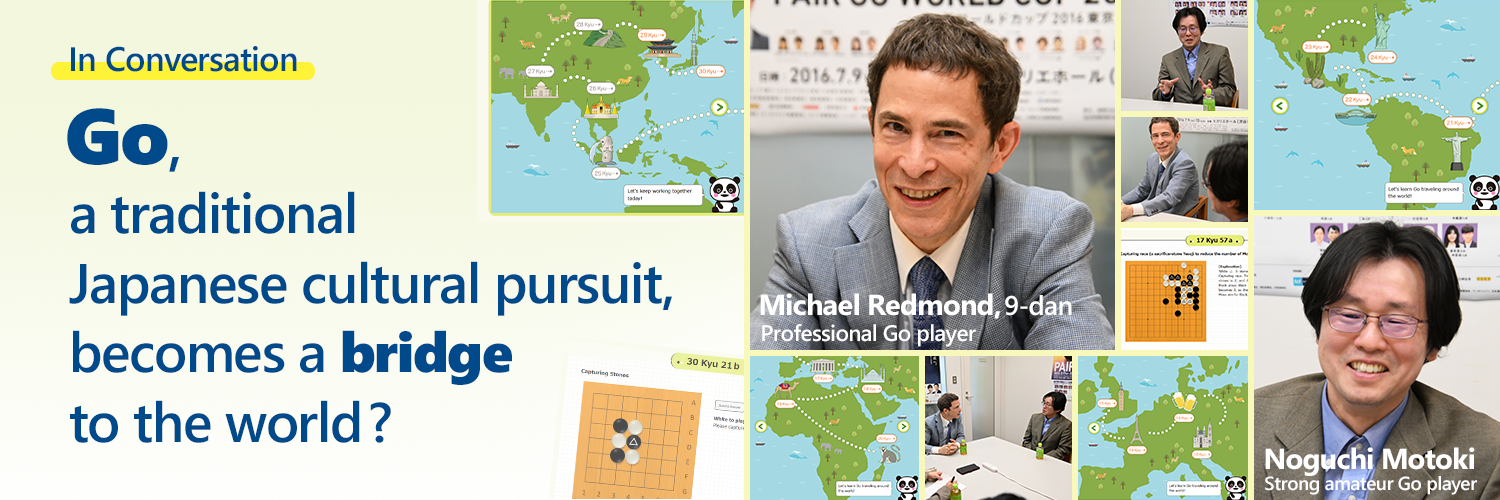
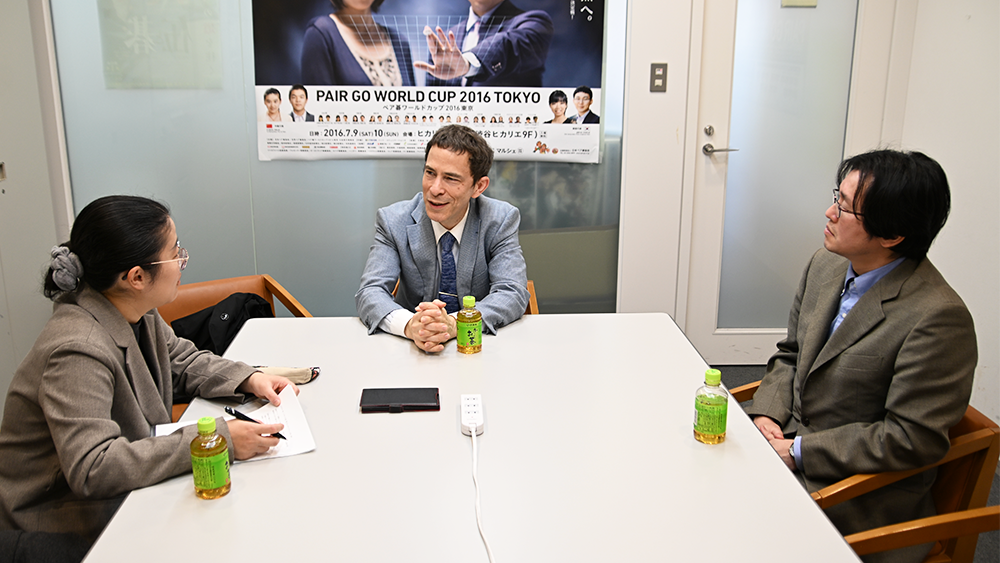
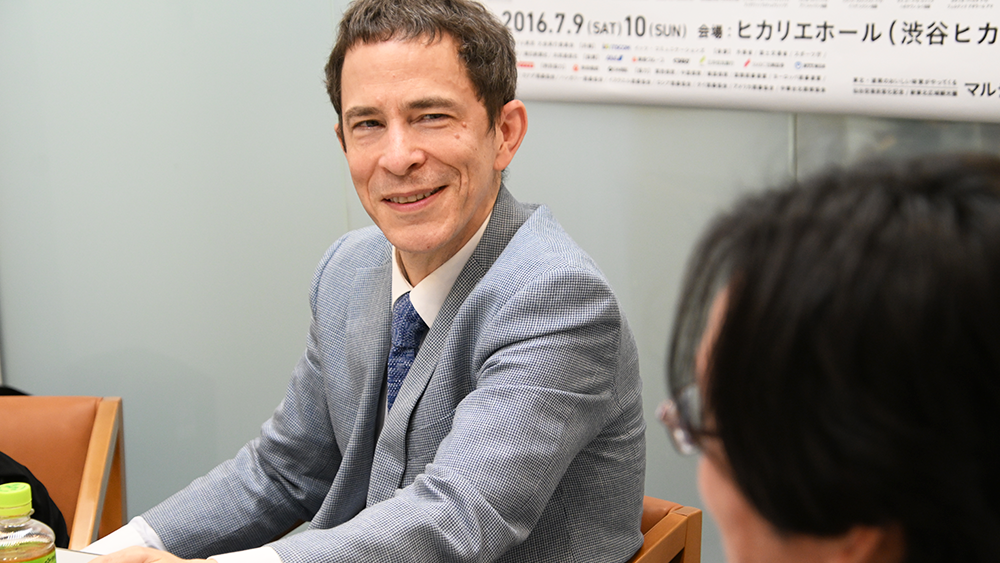
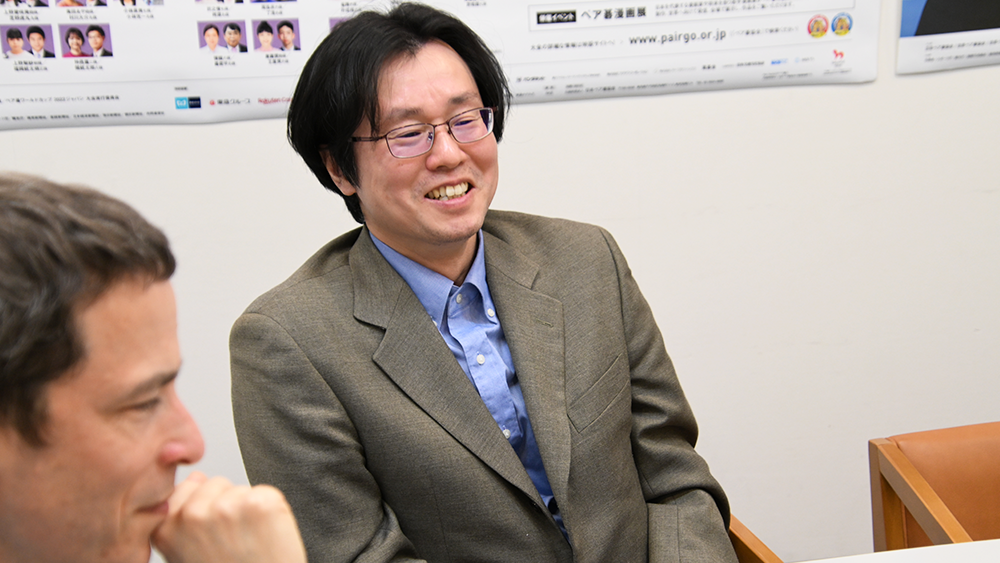
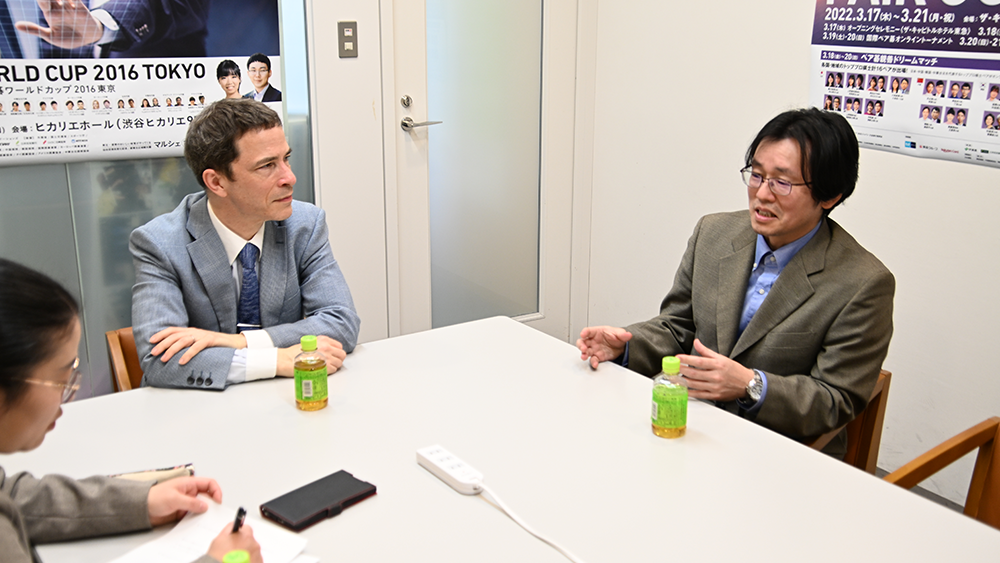
While Go is a traditional Japanese cultural pursuit, like Shogi, it is also a mind sport enjoyed by many people around the world. Here we present a discussion between Michael Redmond 9-dan and Noguchi Motoki, a translator. Redmond 9-dan was born in America and became a professional Go player in Japan. Mr. Noguchi was very successful in the Tokyo University Go Club. Later, he moved to France, where he worked to spread Go. In short, these two people have a profound knowledge of both the traditional cultural pursuit of Go and also its role as a competitive sport.
The topics discussed are:
1. How the traditional Japanese cultural pursuit of Go became a global mind sport;
2. What is necessary for Go to become more popular around the world;
3. What cultural role Go can play in a world situation become ever more divisive and in which the misfortunes of war are endless.
Taking America and Europe as examples, they consider on a broad level the potential of Go.
To start with, they discuss how the traditional Japanese cultural pursuit of Go became a global mind sport. Next, while reviewing history, they examined how Go is regarded at present.
MR = Michael Redmond
NM = Noguchi Motoki
1. Go is a part of traditional Japanese culture and also a mind sport
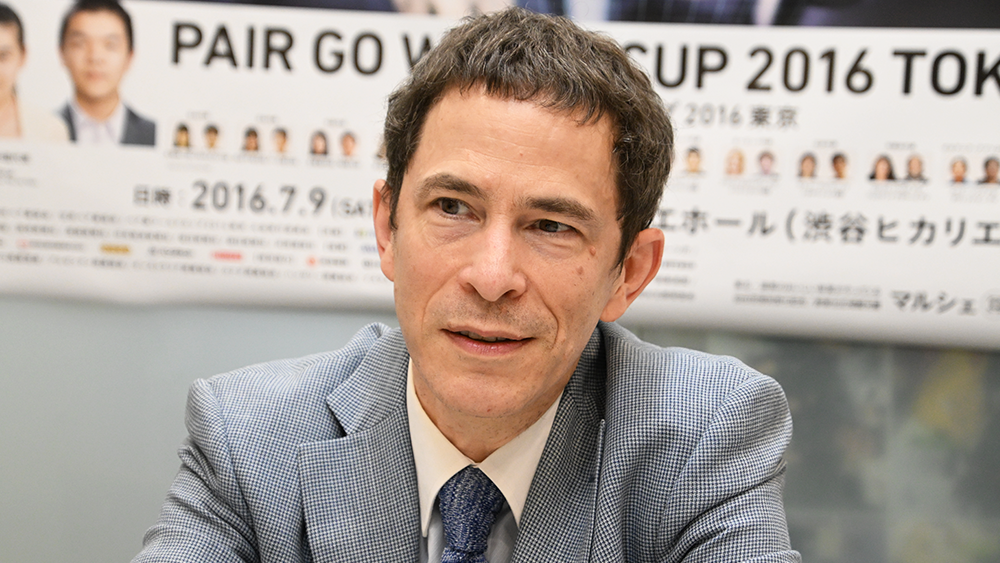
Professional Go player
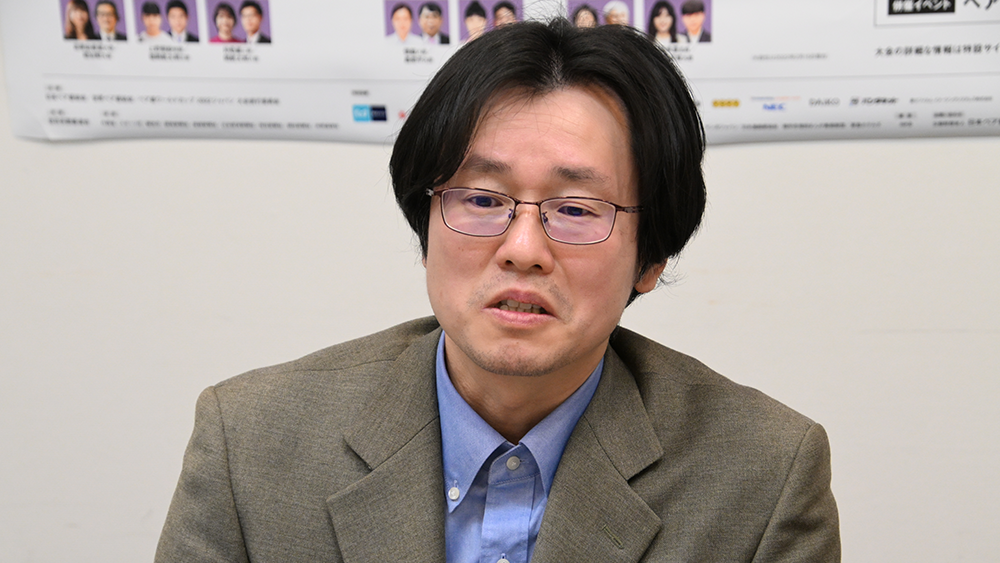
Strong amateur Go player
Interviewer: We would like to hear from two persons who have a broad view of the potential of Go. First of all, the key question is: Why is Go regarded as part of traditional Japanese culture?
NM: It’s because Go underwent a major development in Japan. It was transmitted from China in the Asuka period (592‾646), became popular with the aristocracy and the warrior class and was supported by the government in the Edo period (1600‾1867), so the game developed. For that reason, Japan took the lead in Go culture for a long time. Japan also played the central role in spreading Go to Europe and America.
MR: I became a professional player in Japan because I saw Japan as the center of Go. Also, because Japan was enthusiastic about spreading Go overseas, you can see the influence of Japan in various places in America’s Go culture. For example, the Japanese have the concept of “beginning in courtesy, ending in courtesy.” In America, we have the concept of “sportsmanship,” but saying “please play a game” when beginning and “thank you” when ending is not widespread in sports and board games. But even in America we follow this etiquette when playing a game. We say “Have a nice game” when beginning a game and “thank you” after ending it. In America, it’s the first thing taught in Go classes.
Interviewer: When Go was transmitted from Japan, it wasn’t just the rules, but also the cultural side.
NM: It’s the same in Europe. You can see the influence of Japan in Go etiquette and the method of counting territory and the terminology that is used. In that sense, you can say that the mind sport of Go that is widely known around the world is a natural extension from Go as a traditional cultural pursuit. At the same time, there is a movement to internationalize Go, ignoring the differences between professionals and amateurs, for example, so that more people from diverse cultural backgrounds can take part. Other examples are: simplifying the rules, shortening the time required for a game, switching from playing on tatami (straw mats) to using chairs.
Interviewer: The different aspects influence each other.
NM: I believe so.
Interviewer: By the way, how far has Go been spread around the world?
NM: When the International Go Federation was founded in 1982, there were 29 member countries and territories. At present, there are 79. In particular, there are many fans in Europe and in north and south America. It’s a standard option for people looking for a hobby.
MR: I learnt Go in America when I was ten. I was taught by my father, who was a physicist. We lived in Santa Barbara in California. At that time, even if you wanted to play Go, there were only about ten players living nearby. The only option was to make the three-hour car trip to Los Angeles. Even so, when I got stronger, there were no high-dan players. If you wanted to get stronger, the only option was to go to Japan. But now there are Go clubs in many localities and it’s possible to reach professional level in America. America is a big country, so even now there are areas where it’s not easy to find face-to-face opponents, but the Go population has definitely increased.
NM: I went to France in 2000. Even at this point, there was a big Go population, but there was no comparison with the Go population nowadays. Initially, Go became popular with people like engineers, programmers, mathematicians ? at this time, the game was popular with a small number of eccentric people. Now, however, it’s become popular with women and children and even people who don’t know the rules are aware of the existence of the game and you sometimes hear it mentioned in everyday conversation.
Interviewer: Even in Japan, it’s rare to hear the game referred to in everyday conversation, so that’s a surprise. How is the term used?
NM: There was a famous politician who when asked about his election strategy said: “This election is not like chess but like Go.” Also, there’s a German politician who put a picture of a Go board on the cover of his manifesto about his diplomatic strategy.
Interviewer: Go is often used as a metaphor in political discussions. Are there many politicians who are Go fans?
NM: I wonder. Although a Go board was used on the cover of that German manifesto, the position on the board was quite strange. That led to criticism from a lot of Go fans. So there may not be so many actual fans in the political class. But it does seem reasonable to claim that the existence of the game is widely known.
Interviewer: We now know clearly that there has been a great increase in the number of Go fans in the last 50 years in Europe and America. But in what way did Go spread? Was there something that triggered the increase?
MR: In America, the popularization of the Internet was the first factor that led to an increase in the Go population. America is a really big country. It may be just one nation, but it takes from 5 to 6 hours to travel from California to Washington D.C. Naturally enough, you can’t play face-to-face games, but with the Net you can play with people all around the world.
Interviewer: Our company has been running an Internet Go-playing site for 30 years. The provision of a Go-playing environment for the Net has been a factor in the popularization of Go in America.
MR: That’s right. I think that at the time the Pandanet site was called the IGS, but its impact has been immeasurable. I think that it would not be an overstatement to say that the popularization of Go in America went hand-in-hand with the popularization of the Net. For example, the Redmond Cup, with the founding of which I was involved 30 years ago, is the oldest children’s tournament in America. We were able to create the tournament thanks to the popularization of the Net. When you think of the cost of transportation, it is not realistic to make all the games face-to-face ones, so the games up to and including the semifinals are played online. The final is played at the American Go Congress, a celebration of Go that is staged every year with participation from all around the country. These days most tournaments held in America follow this format.
NM: The role of the Net in popularizing Go is the same in Europe. I think that another extremely big factor has been the existence of the manga “Hikaru no Go.” The French love manga, and there are many fans of Japanese manga and anime. The publication of the French translation of “Hikaru no Go” happened just when I was trying to popularize Go. At this time, people who had no connection with mathematics and knowledge engineering came into contact with Go, and there was a big increase in the number of women and children playing Go.
MR: In America there were many people who were stimulated by the appearance of the AI Go-playing program AlphaGo, developed under the auspices of Google, to take up Go.
Interviewer: So, first of all, the technological revolution of the Net became the base, and the social phenomena of “Hikaru no Go” and AlphaGo further promoted the popularization of Go.
NM: That’s right. The only thing is that even if you have this technological revolution and these social phenomena, popularizing Go won’t progress without people to link them to the Go community. How do we scoop up the people who want to try Go and include them in the Go community? In Europe and America, there are people who have worked steadily against this background. Our task is to continue to strive to spread Go while building upon their efforts.
2. The keys to popularization are “instructors” and methods”
Go is a traditional Japanese cultural pursuit and also a mind sport enjoyed around the world. In order to explore its potential, we interviewed Michael Redmond 9-dan, a professional Go player, and Noguchi Motoki, a translator.
In the previous installment, we considered how the traditional Japanese cultural pursuit of Go became a global mind sport. In this installment, we consider what is necessary for Go to become even more popular around the world. In the final installment, we will consider the cultural role that could be played by Go in a world situation in which divisions are deepening and the turmoil of war is endless.
Interviewer: I would like to ask what is necessary for Go to become even more popular around the world in the future. The International Go Federation has 79 countries and territories as members. Among them, Go has made a lot of progress in Europe and America. What are our future goals?
MR: The chore in America is the consolidation of a professional system.
Interviewer: Are the professional systems in Europe and America different from those in Japan, China, and Korea?
MR: The American Go Association founded a professional system in 2011 and so far several people have become professionals, but there are no domestic tournaments like those in Japan, China, and Korea. With just modest sponsorship and favorable treatment, it doesn’t reach the level of providing a livelihood.
NM: In Europe, a professional system was founded in 2014, but the situation is the same as in America. Everyone is hoping for the emergence of top players who could compete on a global level, but they need side jobs to make a living. It’s hard to advance above a certain level. Well, if you ask how to make it possible for players to make a livelihood just from Go, we need the Go population to expand, for the level of social acceptance to arise, for fans to increase, and for sponsors to appear. I think the important thing for the professional system to be consolidated is to popularize Go even more and to increase the number of players even more than now.
Interviewer: Even in Japan, the Go population is shrinking, so popularizing Go further is an urgent task. What do you think needs to be done to spread Go further?
NM: The president of the European Go Association said that the keys to popularizing Go were “instructors” and “methods.” If the people who are interested in Go do not teach or we are not blessed with good instructors, Go will not spread. Also, the way you teach is extremely important; just knowing the game does not mean you can teach it.
MR: In particular, when high-ranking players who became strong when they were children try to teach, they tend to get confused about what to explain. I teach an introduction to Go in the general education courses at Chiba University, and I have felt that playing games and teaching are, after all, completely different things.
NM: I have taught extracurricular classes on Go at a French elementary school, but it was really tough for me. I believe that it’s essential to train people as instructors and to brush up on teaching methods.
Interviewer: Our company has cooperated with the company Kumon LIL to release the Pandanet Introduction to Go, which makes it easy for people to learn Go online. At present, we are preparing to put out an English version.
MR: The Kumon Group is a company that operates not just in Japan but also overseas. It’s also famous in America. Also, online culture is more advanced there, so I’m glad there’s a digital version. I’ve actually had a look at it. It progresses in small steps and is easy to understand. One excellent feature is that it has a large number of practice problems on the end of a game, which is hard for beginners to understand.
NM: The Kumon style is a refined method with 70 years of history. I’ve also had a look at it. There are many practice problems, so it’s not only good for private study ? it also has content that instructors would be grateful for.
Interviewer: Once we get the English version on track, our next challenge will be to prepare French and Spanish versions. Do you think there is potential?
NM: I think that there is a big latent demand ? not only in France, of course, but also in the numerous countries in Africa where French is an official language. At present, only three African countries ? Madagascar, Morocco, and South Africa ? are affiliated with the IGF, so it’s hard to say that Go has been really popularized in Africa. But Europe and Africa are quite close geographically. There are many people living in France whose roots are in Africa, and there’s a lot of traveling back and forth. I think that there is a strong possibility that Go could be popularized through such exchange. If this happens, then using the Kumon Go-teaching method at this stage might be a big help to both beginners and instructors.
Interviewer: How about popularizing Go in the Middle East ? though at present the regimes are unstable?
NM: I have heard that there are people interested in Abu Dhabi and Dubai. Also, this year the European Go Congress is scheduled to be held in Ankara in central Turkey. While Go is a traditional Japanese cultural pursuit, the rules are simple, and the lack of a strong regional identity is an appealing aspect. It is profoundly universal, so I believe that it has the potential to be accepted in any area.
MR: The thing I like most about Go is that in the Go bowls the stones are equal and have no value, yet once you place a stone on the board, it acquires its own value and plays a role. Moreover, this value changes as the game develops. This is a feature absent from board games like chess and Shogi. There is nothing similar. That’s why the game spread in Europe and America, so I think there is plenty of potential for Go to spread in Africa and the Middle East.
Interviewer:The Go population is shrinking in Japan, but if the game flourishes overseas, the number of people in Japan taking an interest in it may increase.
MR: I travel to America every year and each time I am astonished by how many young people play Go. For their part, American players can’t understand why Go is considered a game for young people in Japan. If the perception changes, the number of people playing Go might well increase.
NM: Earlier I said that Europeans were hoping for world-level players to emerge in Europe, but I think that the same thing is true of people in southeast Asia. At present, Japanese, Chinese, Korean and Taiwanese players dominate international tournaments and usually players from these four countries and territories compete for the top places, but how would it be if players from a wide area, including America and Europe and southeast Asia, were also competitive. That would make the tournaments more international and more interesting for spectators. If there were top-level players in each country, international tournaments might be founded in America and Europe.
Interviewer: When your turn your gaze away from conditions within Japan, the state of Go looks different.
3. Go becomes a force transcending division
Interviewer:Since its founding, our company has engaged in the task of popularizing Go more overseas. Also, we have focused on the point that Pair Go, invented by Taki Hisao, the husband of the company president Taki Hiroko, places equal weight on competition and on the exchange that people experience playing Go. In particular, we have positively promoted international exchange through the International Amateur Pair Go Championship. That is because Mr. and Ms. Taki believe that popularizing Go and Pair Go contributes to world peace.
MR: I agree that Go is a competitive sport but it is also a peaceful game. For example, I feel that in America there’s an abrasive atmosphere and that the view of America by other countries has become very stern, but the strange thing is that none of this is apparent in Go tournaments. This is because in the intercity tournament, the City League, which is sponsored by Pandanet, teams from both the politically red and the politically blue states take part, so there is no unfriendliness among the competitors. Also, I am sometimes invited to European tournaments. I have never experienced any unpleasantness because of being an American.
NM: Venues for hobbies are important because you can have exchange without worrying about race or politics. There are also European competitions sponsored by Pandanet, and every year the participants look forward to them. Because of the attack upon Ukraine, Russia has been unable to participate, but I believe that continuing this exchange is very important.
Interviewer:Do you think that Go has the power to overcome divisions?
NM: I think that not only Go but also the cultural activities of sports and arts has the power to overcome division and to link people. However, I feel that people who play Go have an advantage because they can interact with anyone on terms of equality. I think that Go has great potential for linking people.
Interviewer:What do you mean by “interact with anyone on terms of equality”?
NM: When I went to France, there were many people who had switched from chess to Go. A comment I often heard was: “Chess has a strong hierarchy, so beginners can’t approach high-level players. But in Go no one looks unhappy at being spoken to. This friendly atmosphere is nice.” This may be because of my partiality for Go, but I believe that people who play Go have a deeply rooted conviction that Go players are all friends, regardless of race or gender or age or strength.
MR: This may be a feature of Go. In the Japanese professional system, there are seats for overseas players and a special qualifying tournament for female players. My impression is that the gate is open wide.
Interviewer:On the other hand, antagonism toward migrants has increased and wars have started in various places, so conditions remain severe.
NM: European Go received considerable damage from the Russian invasion of Ukraine. Originally, relations between Ukrainian and Russian players were really good. Russian players have been shut out and Ukrainian players find their livelihood threatened, so the situation is dire. Artem Kachanovski 3-dan, one of the ten professionals, who lives in Kiev, is a very strong player and even now he is active as a professional, but there are times when he can’t play, for example, because of the periodic blackouts. He’s faced with various restrictions. With things the way they are, it’s going to be a very long time before they can resume their previous relationship of exchange. The situation in Iran is also a great worry. In particular, this year the European Go Congress is scheduled to be held in Turkey, so we can only hope that the war doesn’t spread any further.
Interviewer:Even if you construct a relationship through Go, it’s destroyed in an instant if a war breaks out. You have a feeling of helplessness.
NM: That’s right. However, I believe that even if the relationships that European Go has cultivated, including those with Russia, are severed during the war, they will not go to waste. After the war ends, the cultural exchange and connections will reassert their power. Actually, the fact that Japan was able to return to international society after WWII was not unrelated to cultural exchange, such as through Go.
Interviewer:It’s certainly true that Go Seigen 9-dan and Honorary Kisei Fujisawa Hideyuki became bridges between Japan and China after the war.
NM: 418 people in 209 pairs from 35 countries and territories (including from within Japan) took part in the Pair Go World Festival held at last year’s Osaka Expo and deepened their exchange. On the day before the tournament, the general meeting of the PGPP (Pair Go Promotion Partners) was held, with officials of the World Pair Go Association and competing pairs from each country or territory in attendance. The fact that so many people from so many countries and territories assembled together is meaningful in itself. Also, besides the official exchange, the players engaged in private exchange, exploring the city of Osaka. I think that the more that people with this kind of exchange increase, the more the world will approach peace little by little. That’s what I hope for.
Interviewer:Today, in interviewing the two of you, we started with the claim that Go is both a traditional cultural pursuit and a mind sport, we discussed how Go spread around the world and addressed the question of what was necessary to popularize it even further. We discussed on a broad basis the significance of interaction through Go. By turning our gaze onto world Go in our discussion, we became freshly aware of the potential of Go and also felt the desire to protect traditional Japanese culture and to spread it further. In order to popularize the game further, our company hopes to offer various tools, including an English version of the “Pandanet Introduction to Go.”
Interview conducted on April 16, 2026